30 Prompts for AI Video Scripts — Complete 2026 Collection
·Асанов Усен·12 minpromptsAIscriptYouTube
The prompt is 80% of the result. A good prompt gives you a script that doesn't need rewriting. A bad one produces "academic" text that viewers will close by the 15th second.
Here are 30 tested templates for different niches. All tested on the Goutub pipeline in 2026. Drop your topic into [ ] and the script is ready.
Explain [topic] so a smart 10-year-old could understand it. Use everyday analogies. No jargon for the first 2 chapters — then gradually introduce concepts.
💡 The best format for channels about physics, biology, economics.
10 little-known facts about [topic] that change the common perception. Each fact backed by a specific source and reasoning. No filler, no emotional exaggeration.
Why [phenomenon] happens — a deep dive into root causes. Start with what most people mistakenly think is the cause. Then reveal the actual mechanism.
The history of [object/phenomenon] — from invention to today. 5-6 key turning points. Hook: "Without this invention, [modern thing] wouldn't exist."
If [famous figure] were alive today — what would they say or do about [modern issue]? Base it on their real principles and work.
Debunking 5 myths about [topic]. For each myth — where it came from, why it's so widespread, and what the science/facts actually say.
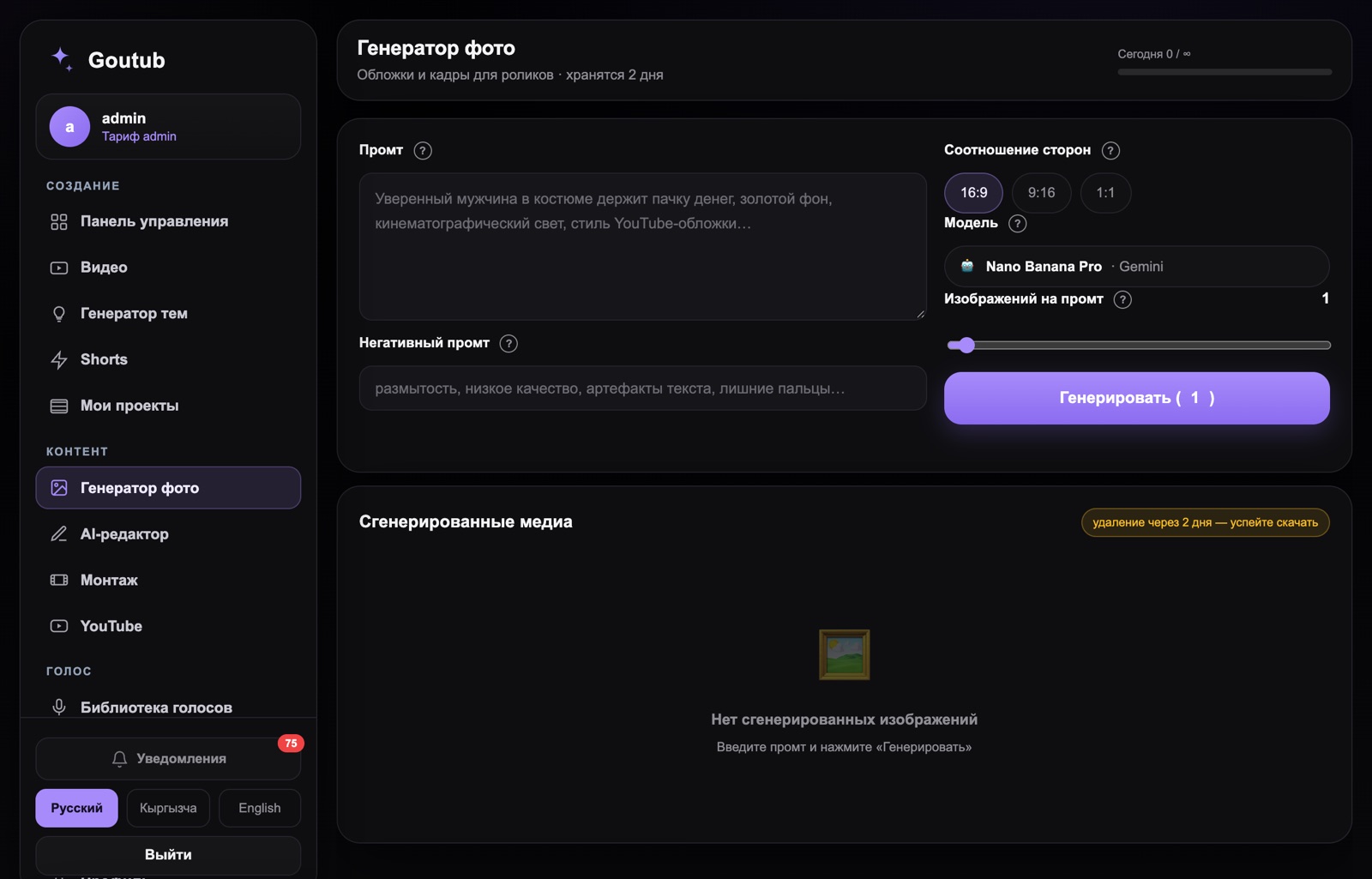
Картинки для видео и обложек генерируются внутри платформы.
📖 Storytelling
Tell the story of [person / event] like it's a thriller plot. First-chapter hook: one gripping fact with no context. Add context gradually.
Case study: "how [name] built [company/project] from scratch." Key moments: the first idea, the first failure, the pivot, the moment it became clear it would work, the current state.
The dark side of [a well-known success/phenomenon]. What usually gets left out. No conspiracy — only verifiable facts. Tone: journalistic, no moralizing.
Minute-by-minute timeline of [a major event]. From the first sign to the resolution. Use exact dates and times. The viewer should feel how it unfolded.
Failure case study: what went wrong at [project/company]. Not just "they made a dumb mistake" — a structural analysis of which decisions seemed reasonable but led to disaster.
A parallel between [a current event] and [a historical parallel]. What's similar, what's different, what lessons can be drawn. No forced comparisons — only substantive parallels.
🛠 How-to / tutorials
Step-by-step guide to "how to do [X]" for beginners. 5-7 steps. For each: what to do, what NOT to do, a common mistake, and how to avoid it.
"Understand [tool/concept] in 5 minutes." Only what's immediately needed — no history, no alternatives, no contextual fluff.
Comparison of 3 approaches to [task]: A vs B vs C. For each — when it fits, pros, cons, real cost/time. Final table + recommendation.
"I tried [method/tool] for 30 days — here's what happened." Structure: expectation, reality, surprises, what stuck afterward, who it's for.
Checklist: "before you [important action] — check N items." Each item with an example of what happens if you skip it. Pragmatic, no preaching.
"I was wrong about [topic] for 5 years — here's what I learned." Structure: what I thought, what turned out to be true, why everyone thinks that, what to do instead.
🏆 Top lists
Top 10 [category] in 2026. State the ranking criteria explicitly at the start. Each entry: 1) what makes it stand out, 2) who it's for, 3) an honest downside.
5 [tools/books/places] that changed how I see [field]. Not just a rec list — specify exactly what was the revelation in each.
The worst 5 [category] of 2025 — and what we learned from them. No snark, with a focus on structural mistakes.
7 signs of [a quality/problem] that most people miss. Each sign with a quick self-check test for the viewer.
10 unpopular opinions about [field] — provocative but well-argued. Each opinion: a one-line thesis, 30 seconds of argument, a counter-argument, and why it doesn't hold up.
💭 Opinions / breakdowns
Breakdown of [news/trend] — what actually happened, who won, what it means for the industry in 1-3 years. No hype, no emotion.
Why I no longer [popular activity]. Structure: why I started, when it became clear it wasn't working, what I tried instead, the current state.
Defending an unpopular opinion: [thesis]. Hook: "I know you disagree with me." Then — the strongest arguments, acknowledging counter-arguments.
Predictions for 2027: 5 game-changing trends in [field]. For each: the current state, the direction, the metric we'll use to track it.
📱 Shorts (60 sec)
One fact about [topic] in 45 seconds. Hook in the first 3 sec: "If only I'd known this earlier…" Close with an actionable step for the viewer.
"Do [a simple action] right in 60 seconds." Show 1) the common mistake, 2) the right way, 3) why it's better — each in 15 sec.
"3 signs that [condition]." Each sign — 15 sec: a short example + impact. Close with: "If this sounds like you — [CTA]."
How to use this in Goutub
Copy a prompt, replace [ ] with your topic, and paste it into the "Video topic" field in the Goutub wizard. The pipeline will break it into chapters, write the script, add voice-over, and pick the visuals.
If you don't like the result, don't rewrite the whole prompt. First try changing the tone in the settings (storytelling / educational / casual / serious). That solves 70% of "it's not clicking" cases.
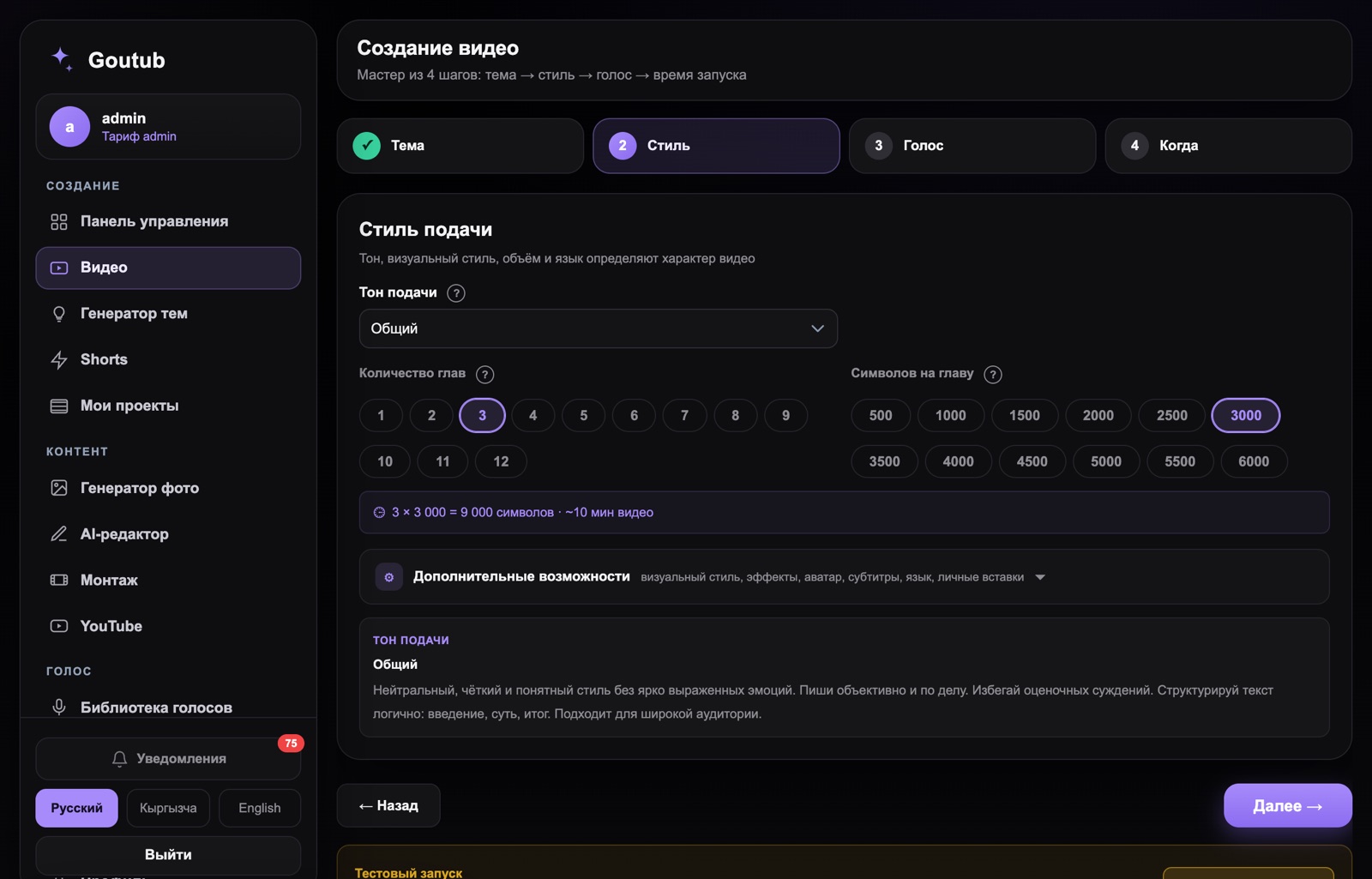
Шаг «Стиль»: сколько глав, какой длины, в каком визуальном стиле.
Try 3 prompts at once
The Starter plan includes 5 videos — perfect for testing different styles on the same topic.